
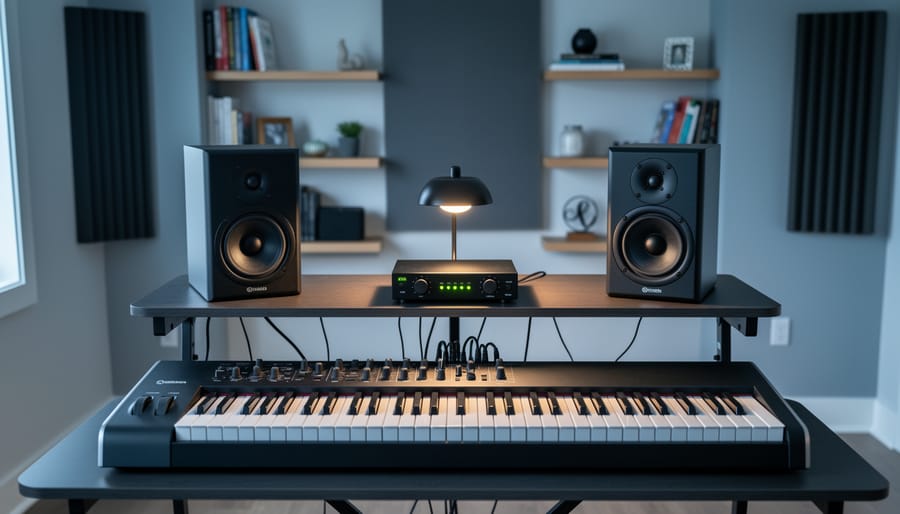
A music production desk is purpose-built workspace furniture engineered to organize audio equipment, position studio monitors at ear level, and provide quick access to controllers, keyboards, and outboard gear during recording and mixing sessions. Unlike standard office desks, these workstations feature tiered surfaces for keyboards and MIDI controllers, integrated cable management, and acoustic considerations that keep your creative workflow smooth and your gear within arm’s reach.
The difference matters more than you might think. When you’re chasing inspiration at 2 a.m. or racing to meet a client deadline, fumbling with monitor angles or tangled cables kills momentum. A proper production desk brings everything into ergonomic position so your hands stay on the keys and faders, not wrestling with your workspace. Whether you’re launching music industry jobs from your bedroom studio or upgrading a professional setup, your desk becomes the command center where ideas turn into finished tracks.
Canadian producers face unique considerations. Urban apartments in Toronto, Montreal, and Vancouver demand space-efficient designs, while pricing in CAD adds another layer to budget planning. Current production desks range from compact $98 models for bedroom setups to professional workstations exceeding $3,100, with an 80-inch studio desk listing at CA$6,375.63 for full-scale facilities. The Armocity 47-inch desk with power outlets, for example, places monitors at eye level in a footprint that works for smaller rooms. Three-tier designs like the Compact 88 accommodate full 88-key controllers without sacrificing studio floor space.
Getting the right desk means matching features to your actual gear and workflow, not just buying the biggest option. Let’s break down what separates a smart investment from an expensive mistake.
Why Your Kitchen Table Isn’t Cutting It Anymore
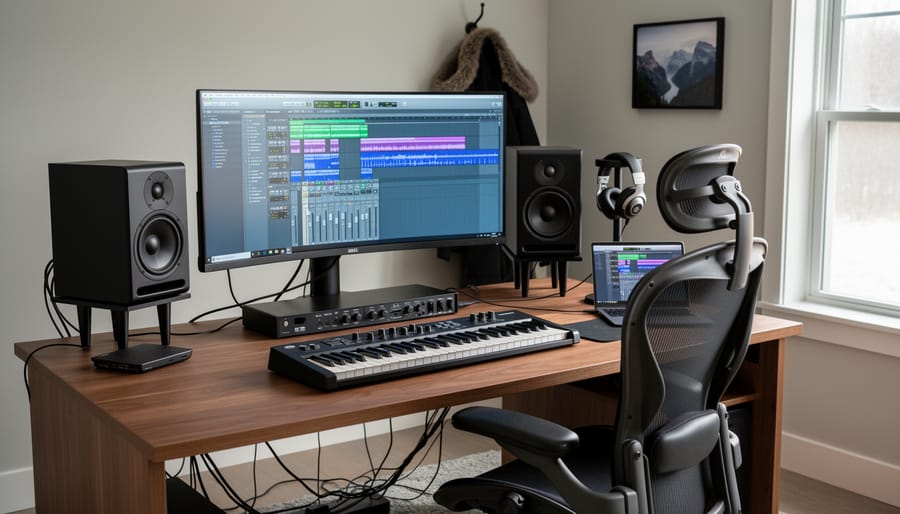
You’re hunched over your laptop at 2 a.m., tweaking that synth line you’ve been chasing all week. Your MIDI controller hangs half off the edge, precariously balanced between dinner plates you pushed aside hours ago. Every time you reach for your audio interface, you risk knocking over your coffee. Again.
This isn’t just inconvenient. It’s killing your creative momentum.
The kitchen table seemed fine when you started producing, but now it’s the bottleneck in your workflow. You spend ten minutes clearing space before each session, another five untangling the rat’s nest of USB cables, XLR leads, and power cords that somehow multiply overnight. By the time you’re ready to record, that spark of inspiration has fizzled out.
For Canadian producers working in Toronto apartments or Montreal lofts where every square foot counts, this setup/teardown cycle becomes exhausting. You can’t leave your gear assembled because you need that table for actual meals. Your monitors sit at completely the wrong height, either craning your neck to hear them properly or slouching to get closer, ignoring every principle in office ergonomics guidance. Your back aches after a three-hour mix session. Your shoulders tighten from reaching awkwardly across cables you can’t properly manage electrical lead risks around.
The real cost isn’t just physical discomfort. It’s the creative opportunities you miss because starting a session feels like a construction project. That vocal idea you had during lunch? Gone by the time you’ve rearranged your makeshift studio. The collaboration you turned down because there’s literally nowhere for another person to sit and contribute?
Your music deserves better than being squeezed between condiments and cutting boards.
What Makes a Music Production Desk Different
A regular desk assumes you’re working with a laptop and maybe a notebook. A music production desk assumes you’re commanding an ecosystem of gear that needs to stay connected, accessible, and ergonomically positioned for hours-long sessions. The difference isn’t just about looking professional, it’s about removing friction from your creative process.
The keyboard tray matters more than you’d think. Most production desks place it 2-3 inches lower than the main surface, positioning your MIDI controller at proper typing height rather than forcing your wrists into awkward angles. The Compact 88 demonstrates this with a three-tier design specifically adapted for eight-octave keyboards, ensuring your full-size controller sits where your hands can play comfortably without shoulder strain.
Monitor placement transforms your mixing accuracy. Production desks typically include elevated shelves or bridges that position studio monitors at ear level, creating the proper listening triangle without stacking them on random books. The Headliner Melrose Production Desk offers adjustable monitor stands with dual shelves, letting you dial in the exact height and angle for critical listening. The Armocity 47-inch desk takes a different approach with a raised stand that brings monitors to eye level naturally, useful when you’re switching between production and casual listening modes.
- Keyboard Tray Depth
- The lowered surface where your MIDI controller sits, typically 25-27 inches deep to accommodate 61 to 88-key keyboards while maintaining ergonomic wrist position.
- Monitor Bridge
- An elevated shelf that lifts studio monitors to ear level, creating the ideal listening triangle for accurate mixing and reducing neck strain during long sessions.
- Rack Unit (U)
- A standardized 1.75-inch vertical measurement for mounting audio interfaces, preamps, and effects processors, allowing modular expansion as your gear collection grows.
- Cable Grommet
- A lined opening in the desk surface that routes power cables, audio connections, and USB lines underneath, keeping them organized and out of your creative headspace.
Rack mounting separates hobbyist furniture from professional gear. Those vertical rails on either side aren’t decorative, they’re standardized mounting points for audio interfaces, preamps, and outboard processors. This vertical integration keeps your signal chain organized and accessible without commandeering your entire work surface.
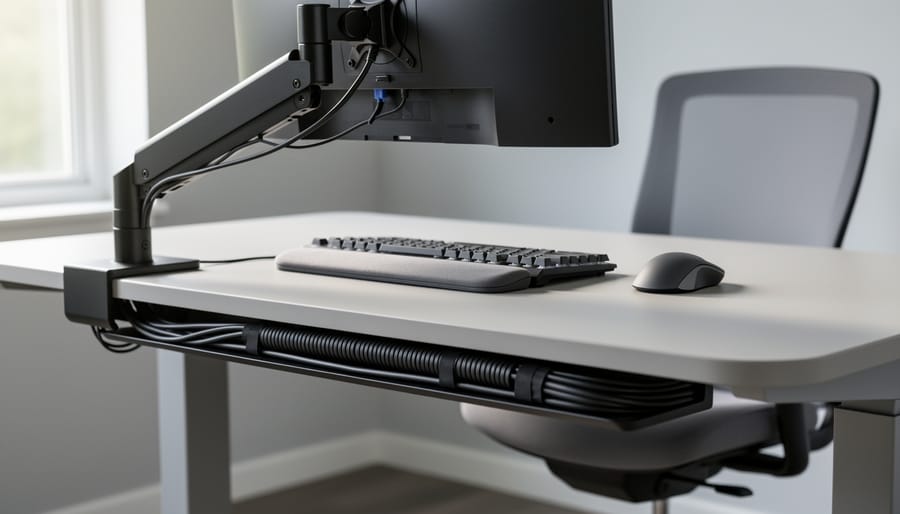
Cable management transforms chaos into workflow. Production desks build in grommets, channels, and under-desk raceways that route your USB connections, XLR cables, and power lines where they belong, out of sight but not tangled into an archaeological dig when you need to swap something. This isn’t about aesthetics; it’s about troubleshooting a signal chain at 2 AM without losing your creative momentum.
The difference shows up in your sessions. A proper production desk keeps your audio interface within arm’s reach, your controllers at playing height, your monitors positioned for accurate mixing, and your cables managed so you spend time making music instead of fighting your workspace.
Finding Your Perfect Setup: Size and Configuration
Compact Solutions for Urban Creators
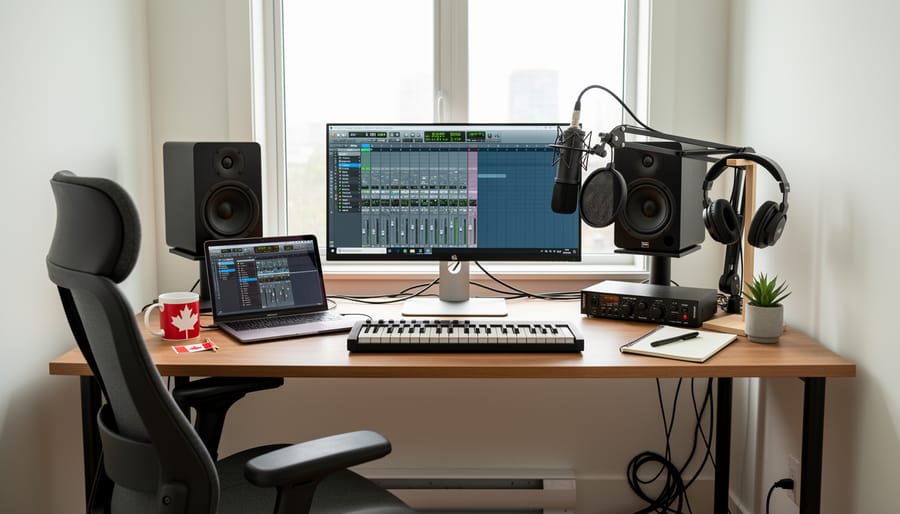
Living in a 500-square-foot Toronto condo or a tight Montreal plateau apartment doesn’t mean sacrificing your production dreams. The secret is thinking vertically rather than horizontally. A three-tier system like the Compact 88 stacks your monitors, keyboard, and laptop in roughly the same floor space as a standard desk, freeing up precious square footage for other gear or simply room to breathe.
Look for desks in that 47-inch range, they fit most apartment nooks without dominating the room. Models with raised monitor stands keep your screen at eye level while creating usable storage underneath for audio interfaces, MIDI controllers, or sample packs. Power outlet integration eliminates the tangle of extension cords snaking across your floor, a lifesaver when every inch counts.
Vancouver studio apartment dwellers swear by corner configurations that use dead space effectively. Mount your speakers on the monitor shelf, tuck your 61-note controller on the keyboard tray, and you’ve got a complete production command center that leaves your kitchen table free for actual meals. The goal isn’t cramming everything in, it’s creating a setup you’ll actually want to sit at when inspiration strikes at midnight.
Expansive Workstations for Growing Operations
When you’re juggling multiple hardware synths, a pair of studio monitors, an audio interface, MIDI controllers, and maybe a collaborator or two, those compact desks start feeling awfully cramped. Expansive workstations, typically 60 inches and up, give you the breathing room to spread out your gear and actually think clearly while you work.
The real advantage isn’t just the width. Larger systems like 80-inch workstations let you create distinct zones: one area for your keyboard and main production tools, another for mixing with multiple monitors, and a third for outboard gear or guest seating when you’re tracking vocals. This separation matters when you’re moving between creative and technical tasks throughout a session.
Modular designs offer the smartest growth path. Instead of replacing your entire setup when you add a new piece of gear, you can expand horizontally with additional side desks or vertically with rack units. Some producers start with a central command station and gradually add wings for synthesizers or a dedicated mixing section as their studio income grows.
Look for systems with cable management that scales with your gear collection, nothing kills the vibe faster than a rat’s nest under a beautiful desk. Sturdy construction matters too; when you’re supporting thousands of dollars in monitors and interfaces, you want something that won’t wobble during an enthusiastic mix session. The investment in a solid foundation pays off when you’re not constantly rearranging gear to make things fit.
Features That Actually Matter for Canadian Producers
Walking into a music store or scrolling through online listings, you’ll see desks advertising dozens of features. But which ones actually improve your sessions, and which just inflate the price tag?
Start with monitor placement. Your studio monitors need to be at ear level when you’re seated, creating an equilateral triangle between your listening position and the speakers. Raised monitor shelves built into the desk solve this immediately. The Armocity 47-inch desk, for example, includes a raised stand that achieves proper eye-level positioning without stacking your monitors on books or foam blocks. Getting this right matters more than most producers realize, positioning the monitor correctly reduces neck strain during those long mixing sessions that stretch past midnight.
Dual monitor shelves let you reference mix levels on one screen while keeping arrangement and plugin controls on another. This isn’t luxury; it’s workflow efficiency. Producers working in Logic or Ableton constantly jump between arrangement view, mixer, and plugin windows. Two screens eliminate the tab-switching that breaks your creative focus.
Power outlet integration deserves serious consideration, especially in older Canadian homes where wall outlets never seem to be where you need them. Built-in power strips mean your interface, monitors, MIDI keyboard, and laptop charger all connect at the desk rather than snaking cables across the room to a single overloaded outlet.
Cable management systems separate essential from frustrating. Open-back desks with built-in channels keep XLR cables, USB connections, and power cords organized rather than tangled in a nest under your workspace. In dry Canadian winters, this also reduces static buildup that can cause mysterious audio pops.
Keyboard trays matter if you’re working with 61-note or 88-key controllers. The Headliner Melrose desk sizes its tray specifically for 61-note MIDI controllers, while the Compact 88 three-tier system accommodates full eight-octave keyboards without forcing you to choose between your typing keyboard and your music controller.
Adjustable height options help if multiple people use the same studio, or if you want the option to stand during creative sessions and sit during detailed editing work.
What You’ll Actually Pay in Canada
The price range for production desks in Canada spans from basic budget setups under $100 to professional workstations exceeding $3,100. What you pay depends less on brand prestige and more on build quality, features, and how the desk supports your actual workflow.
Entry-level options start around $98 for basic studio desks with minimal features. These work for beginners testing the waters, but expect compromises in stability, cable management, and longevity. Mid-tier desks in the $300 to $1,000 range offer better construction, integrated cable routing, and ergonomic features like adjustable monitor stands. The Armocity 47-inch desk with power outlets falls into this practical middle ground. At the higher end, specialized workstations designed for serious production environments range from $1,500 to over $6,000. The 80-inch Large Studio Desk, for instance, lists at CA$6,375.63, reflecting professional-grade materials, extensive rack mounting, and configurations that support multiple monitors and outboard gear.
| Price Tier | Range | Typical Features | Best For |
|---|---|---|---|
| Budget | Under $200 | Basic keyboard tray, minimal cable management, simple construction | Beginners, temporary setups, testing commitment |
| Mid-Range | $300-$1,000 | Dual monitor shelves, power integration, better stability, ergonomic adjustments | Serious hobbyists, emerging producers, most home studios |
| Professional | $1,500+ | Extensive rack space, premium materials, modular expansion, standing options | Full-time producers, commercial studios, collaborative spaces |
Canadian pricing includes additional considerations beyond the sticker price. Shipping costs for larger desks can add $100 to $300, especially for oversized items crossing the country. Currency conversion affects imports from US manufacturers, and you might face customs duties on higher-end models. Factor in these extras when budgeting, particularly if you’re ordering from outside Canada. The desk represents a long-term investment in your creative space, so choosing one tier up from your minimum often pays off in durability and workflow improvements that outlast the initial cost difference.
Beyond the Desk: Building Your Complete Workspace
Your production desk anchors your creative space, but it works best when surrounded by gear and conditions that support long sessions and protect your equipment. Canadian studios face unique challenges, from Saskatchewan’s bone-dry winters cracking guitar necks to Vancouver’s humidity fogging up condenser mics. Building a complete workspace means thinking beyond furniture.
Start with your chair. You’ll spend hours in it, and a wobbly office chair from a liquidation sale will wreck your lower back before you finish your first EP. Look for adjustable armrests that won’t interfere with keyboard playing and lumbar support that keeps you upright during late-night mixing marathons. Mesh backs help in summer when your Toronto apartment turns into a sauna.
Monitor placement transforms how you hear your mixes. Position speakers at ear level, forming an equilateral triangle with your head. Foam isolation pads decouple them from your desk, cutting vibration that muddies low end. In treated rooms, pull speakers a foot from walls. In bedrooms doubling as studios, bass traps in corners tame the worst resonances without major renovation.
Winter heating dries the air enough to split wooden instruments and irritate your throat during vocal takes. A small humidifier keeps conditions stable around 40-50% humidity. Conversely, basement studios in humid climates need dehumidifiers to protect electronics and prevent mold on acoustic panels.
Lighting affects your mood and productivity more than you’d think. Harsh overhead fluorescents kill creativity. Warm LED strips behind monitors reduce eye strain, while a desk lamp with adjustable colour temperature lets you dial in focus for technical work or warmth for creative flow.
The best workspace supports both your craft and your wellbeing. Creating music professionally demands emotional support and practical infrastructure. Whether you’re building toward employment opportunities in the industry or crafting music for your own satisfaction, your environment shapes what you can achieve. Treat your space like the instrument it is.
What Canadian Producers Are Actually Using
Across the Canadian music scene producers are gravitating toward three distinct desk philosophies. Command center setups dominate among hip-hop and electronic producers, with brands like StudioDesk’s Five Command Center and Commander V2 providing the multi-tier, gear-forward approach that keeps everything within arm’s reach. These configurations suit producers who layer hardware synths, drum machines, and outboard processing into their workflow.
Minimalist producers, particularly those working in folk, indie, and singer-songwriter spaces, prefer streamlined two-tier designs that prioritize screen real estate and open space. The 47-inch Armocity desk with its raised monitor stand represents this approach, placing displays at eye level without overwhelming smaller rooms. These setups reflect a laptop-and-interface workflow where software handles most of the heavy lifting.
The right workspace transforms hesitation into confidence, giving emerging artists the professional foundation they need to take their sound seriously.
Standing desk adaptations are gaining traction among producers who split time between music creation and other work, including those juggling music teaching jobs. Height-adjustable frames paired with production-specific tops let creators shift between sitting sessions for detailed mixing work and standing sessions for MIDI programming or vocal tracking.
The Canadian landscape also shows strong adoption of modular systems that grow with careers. Producers start with compact 47-inch configurations in apartment bedrooms, then expand to 80-inch workstations as they move into dedicated spaces or collaborative environments. This scalable approach matches the financial reality of building a production career gradually rather than investing thousands upfront.
Your music production desk isn’t just furniture. It’s the foundation where ideas become tracks, where late-night inspiration turns into finished songs, and where your unique voice as a Canadian artist finds its expression. Whether you’re crafting indie folk in a Halifax apartment, producing hip-hop in a Toronto bedroom, or scoring classical arrangements in a Vancouver home studio, the right workspace removes the friction between your creativity and your output.
The investment you make in your production environment pays dividends every time you sit down to work. A proper desk keeps your gear organized, your workflow smooth, and your focus where it belongs: on the music. From compact 47-inch solutions that fit tight urban spaces to expansive 80-inch workstations that accommodate your growing operation, there’s a configuration that matches both your current needs and your ambitions.
Canada’s music scene thrives because creators like you keep pushing boundaries and finding new ways to express what matters. Your workspace should support that journey, not fight against it. Set up your space with intention, and watch how it transforms not just your productivity, but the quality and consistency of what you create.